Spoken Farsi vs Written Farsi: Why Iranians Don't Sound Like Your Lessons
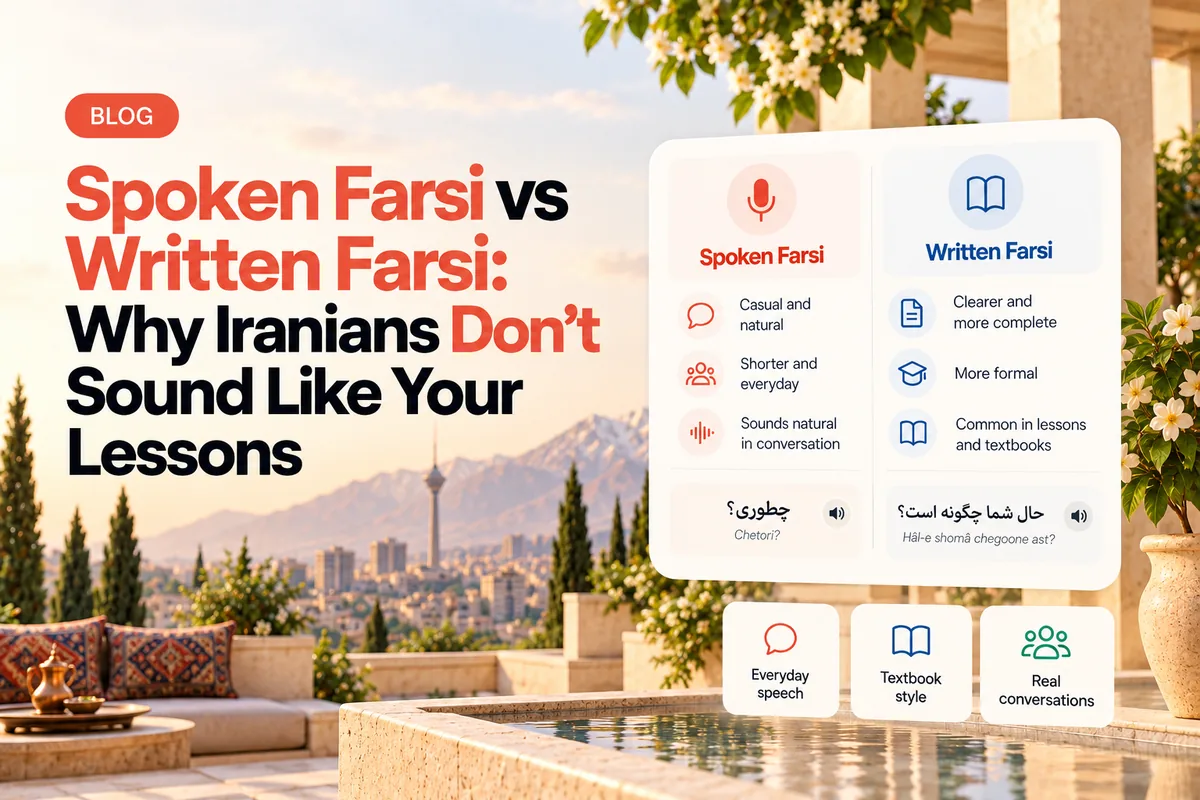
You learned میخواهم. Iranians say میخوام. Five sound changes turn written Farsi into spoken Farsi. Learn them, with real Iranian videos to practise on.

Why Spoken Farsi Sounds Different
You learn میخواهم (mikhaaham), "I want". You review it until it sticks. Then you hear an Iranian say it, and what comes out is میخوام (mikham). Same word, a syllable shorter, and at full speed you might not catch it at all.
This is the gap most Farsi learners hit when they first listen to real Iranians. Persian is written one way and spoken another. Your lessons teach the written form, because that's the one you can read, type and look up. Your partner's family, Persian films and Iranian Instagram use the spoken one.
Here's a home cook starting a video on چلوگوشت (rice with braised meat). Listen for how many words sound different from the ones in your lessons:
▶ Watch the clip on Reelang: طرز تهیه چلوگوشت خوشمزه به روش خانگی, with Persian and English subtitles
"Hello, my lovely friends, I hope you're all really well. Today I'm going to make chelo goosht for you. If you make it this way, I'm sure you'll fall in love with it. It really has a delicious, one-of-a-kind taste."
In a book, her first two sentences would have دوستانِ مهربانم, حالتان, میخواهم and برایتان. She says دوستای مهربونم (doostaaye mehraboonam), حالتون (haaletoon), میخوام (mikham) and براتون (baraatoon). Four changes in eight seconds, and nothing about it is slang. This is simply how Persian is spoken.
Two Ways to Say the Same Thing
Linguists call the spoken form colloquial Persian, and in Iran the most common version of it is the Tehrani accent, the one you hear on TV and in films. Iranians move between the two all the time: written Persian for news, books and speeches, spoken Persian for nearly everything else. One speaker can switch mid-conversation.
You've already met a few spoken forms on this blog. In 50 common Farsi phrases, حال شما چطوره؟ (chetore) is چطور است said out loud, and اسم شما چیه؟ (chiye) is چه است. And in Learn Farsi's list of 10 mistakes beginners make, number four is only learning formal Farsi.
The good news: you don't need a second vocabulary. Spoken Farsi is the written words with a handful of regular sound changes. Learn the changes and you can work out most spoken words from the written ones you already know.
The Five Changes That Do Most of the Work
| Change | Written | Spoken | Sounds like | Meaning |
|---|---|---|---|---|
| "aan" becomes "oon" | آن، خانه، نان | اون، خونه، نون | oon, khune, noon | that, house, bread |
| Verbs lose a syllable | میخواهم، میروم، میگویم، میتوانم | میخوام، میرم، میگم، میتونم | mikham, miram, migam, mitoonam | I want, I go, I say, I can |
| "-ad" becomes "-e" | میرود، میخورد | میره، میخوره | mire, mikhore | he/she goes, eats |
| است becomes ـه | خوب است | خوبه | khube | it's good |
| را becomes رو or و | آن را | اونو | oono | that (as object) |
1. "aan" becomes "oon". Before n or m, the long aa sound often rises to oo: خانه (khaane) becomes خونه (khune), نان becomes نون, بادام (almond) becomes بادوم, and the cook's مهربان (kind) becomes مهربون. The "your" ending ـتان goes the same way, which is why she says حالتون. It doesn't happen to every word. ایران stays ایران. But it happens to the very common ones.
2. Verbs lose a syllable. The most-used verbs shrink in speech. میخواهم becomes میخوام, میروم becomes میرم, میگویم becomes میگم, میتوانم becomes میتونم. The personal endings stay the same, so once you know میخوام you also know میخوای (you want) and میخوایم (we want).
3. "-ad" becomes "-e". Learn Farsi's post on verb conjugation lists the he/she ending as "-ad / -e". That second form is the spoken one: میرود (miravad) is میره (mire) out loud. "They" works the same way: میروند (miravand) becomes میرن (miran).
4. است becomes ـه. "Is" mostly disappears into a short e on the end of the word before it. خوب است becomes خوبه, کجا است becomes کجاست or کجاس. That's where چطوره and چیه come from.
5. را becomes رو or و. The object marker را (covered in our Farsi grammar guide) usually turns into رو after a vowel and a plain o after a consonant: من را becomes منو (mano), آن را becomes اونو (oono).
There's also یک → یه (ye) for "a, one", and اگر → اگه (age) for "if", which the cook uses in her third sentence.
How often will you run into these? Reelang counted them in their transcripts of 667 short native Iranian videos (cooking, family sketches, interviews), only ones whose dialect a native speaker had confirmed:
- یه appears in at least 65% of them
- one of the four short verbs (میخوام, میرم, میگم, میتونم and their other forms) in at least 56%
- اون in at least 39%
- خونه in at least 19%
Those are minimums, because the transcripts are machine-made and sometimes write the bookish spelling for a word that was said the spoken way. In a typical one-minute native video, you'll hear at least one of these short verbs more often than not.
Iranian Mums in a Parallel Universe
Here's a sketch from comedian Sasan Keshani, about what Iranian mums would be like in a parallel universe:
▶ Watch the clip on Reelang: مامانهای ایرانی در دنیای موازی, with Persian and English subtitles
"Mum, I'm going to my friend's house, I'll be back soon." "Why would you want to be back soon? Go and have fun, stay the night at your friend's. Here, son, take my card and spend as much as you like." Then she phones her sister: "Hi sister, I called to see how you are. So you're fine, then? Bye!"
The joke only works if you know the real version, the mum who wants you home early and the phone call that lasts an hour. Listen for the language too. میرم خونه (miram khune) is میروم به خانه in a book: a short verb, the "oon" sound, and the destination simply follows the verb, with no به. Then واسه چی (vaase chi, "what for") is the spoken version of برای چه, and میخوای (mikhaay) is "you want". The پسرم (my son) is the same "-am" ending as in terms of endearment.
That habit of putting the place after the verb is worth noticing. Learn Farsi's guide to the CEFR levels uses آخر هفته به بازار میروم as an A2 example. In everyday speech you'll usually hear it as آخر هفته میرم بازار.
A Word That Looks Nothing Like Its Spelling
Most spoken forms are easy to link back to the written ones. A few are not. Here's a guest on an Iranian podcast explaining what she does after losing an argument:
▶ Watch the clip on Reelang: چطور بعد از دعوا حالم را خوب میکنم, with Persian and English subtitles
"You know the situation: you've argued with someone, at some point the argument is over, but it's still stuck in you, you're angry and all that." "I go home, stand in front of the mirror, act out the rest of it, win the argument, and feel better."
میرم خونه again. But listen for وایمیسم (vaaymisam), "I stand". In a book that's میایستم (mi-istam). Few learners would connect the two on first hearing, which is why it helps to meet spoken forms in context, where the picture and the situation tell you what the word must mean. Notice اینا (inaa) at the end of her first line too. It's اینها, "these", used the way English uses "and all that".
Bread, Rent and a Change of Heart
One more, because it has نون in it. Sasan again, with a couple who have been planning to emigrate to Canada and talk themselves out of it:
▶ Watch the clip on Reelang: شوخی با مهاجرت به کانادا و سختیهای ایران, with Persian and English subtitles
"Susan, I've changed my mind. I want to stay right here and be crushed under all these problems." "Yeah, me too. I'm heading out now to hustle and scrape the rent together. And for tonight, if you can, buy a bit of bread and we'll have it with tomato paste, okay?"
میخوام, میرم, خونه (in اجاره خونه, "rent"), نون, and باشه (bashe, "okay"), the spoken form of باشد. Count the changes and you'll find almost every rule from the table in fifteen seconds.
How I'd Fit This Into Your Practice
Keep your free Farsi lessons and daily review as the base. The written forms are what you read, type and look up, and every spoken form is built on them. Then add the spoken side on top:
- Learn both forms of your top verbs. When a common verb comes up, say the spoken form next to it: میخواهم / میخوام, میروم / میرم. It costs a few seconds per word.
- Learn the five changes as sound rules, not new words. Once "aan → oon" clicks, خونه, نون and اون stop being new vocabulary.
- Listen to short native videos on topics you know. As Learn Farsi's guide to structured learning plus real content puts it: after a food lesson, watch a Persian cooking video. Cooking and family sketches are easy to follow, because the picture carries the meaning.
- Read Persian subtitles, not English ones. Subtitles for spoken videos are written the way people speak (میخوام, not میخواهم), so you see the spoken form and hear it at the same time.
A note on scope: everything here is Iranian Persian, the Tehran-style speech you hear in Iranian films and on TV. If you're learning Dari, spoken Dari changes in its own ways, and some of these rules don't apply. And if you're one of the heritage speakers who grew up with Persian at home, you probably have the opposite gap: you know خونه and want to learn خانه.
For the videos in this post I used Reelang, a free feed of short native videos, a bit like TikTok, with Persian and English subtitles. Every video is graded for difficulty, so you can start with ones you can almost understand, and you can keep to Iranian Persian only. Native speakers check which dialect each video is in, and the subtitles in the clips above were checked by native Persian speakers too.
Spoken Farsi isn't a different language. It's the one you're already learning, said the way people actually say it.