
Farsi Grammar
Free Persian Grammar Lessons, Beginner to Advanced
Learn one pattern at a time, then use it in real sentences. Start with a public lesson below, or explore the full free web course: 93 lessons from your first sentence to advanced tenses.
Three lessons you can finish here
Clear explanations, Persian examples and 10 practice questions each. Free in your browser, no account needed.
Lesson 1 · About 7 minutes
Say “I am” in Persian
Introduce yourself and say what someone is or is not.
Learn and practise →Lesson 2 · About 7 minutes
Use the Persian ezafe
Build noun phrases with an owner, a description or both.
Learn and practise →Lesson 3 · About 8 minutes
Use the Persian present tense
Say what you and other people do using common present-tense verbs.
Learn and practise →
Persian Grammar Is Easier Than You Think
Three big reasons Farsi is one of the most beginner-friendly languages around
No grammatical gender
Nouns have no masculine or feminine forms. او (u) means both “he” and “she”.
Regular verbs
Learn a verb's stem, then add the ending for I, you, we and so on.
Simple word order
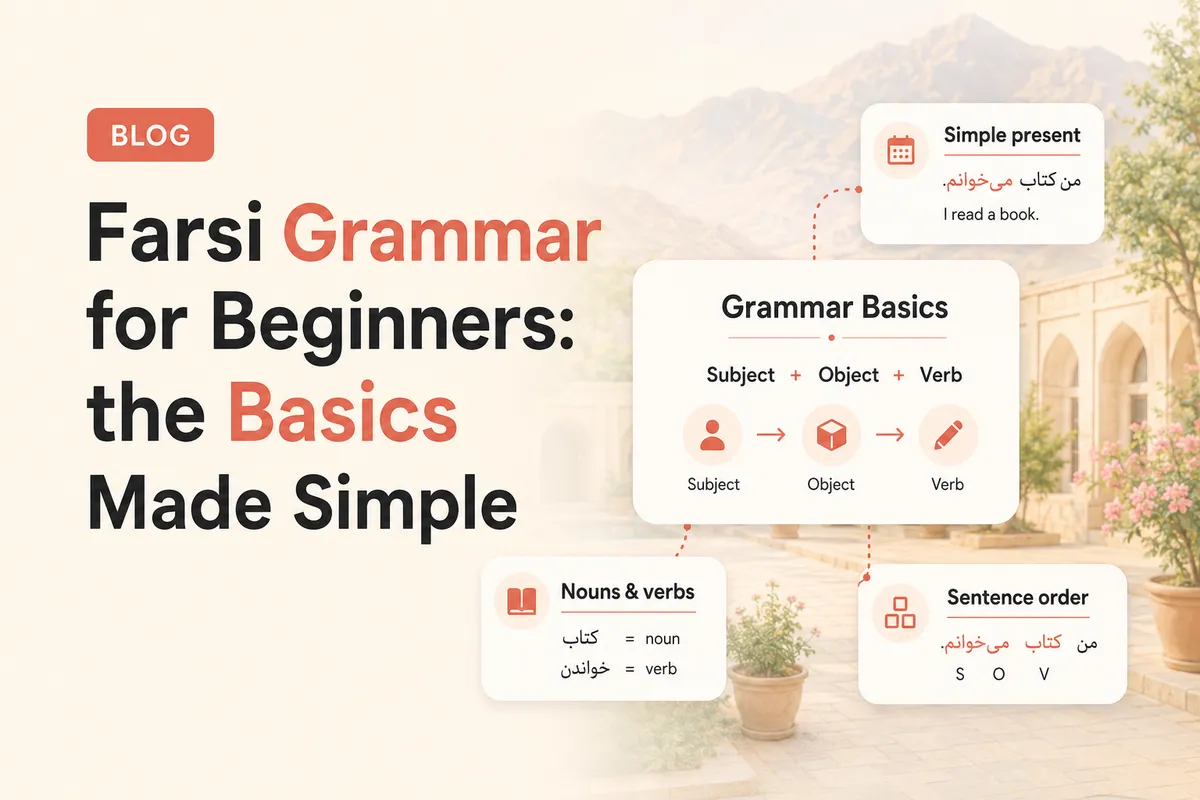
Usually: who + what + action. Think “I rice eat” instead of “I eat rice”.
93 Free Grammar Lessons on the Web
Each lesson is short and focused, a clear explanation, a few real Persian examples, and interactive exercises so you actually use what you just learned. Here's a taste of how it goes:
Example: Persian Pronouns
Persian has six personal pronouns and — unlike English — the same word covers both “he” and “she”.
| I | من | man |
| you | تو | to |
| he / she | او | u |
Example: The Ezafe (-e)
The little “-e” sound after a noun glues it to whatever describes it — like a tiny “of”.
کتاب من
ketâb-e man — “book of mine” (my book)
Example: Present Tense Verbs
Take a verb stem, add the prefix mi-, and one of six personal endings. That's it.
من میروم
man miravam — “I go” (mi- + rav stem + -am ending for “I”)
Keep Going
Grammar is one piece. Pair it with vocabulary, the alphabet, and daily practice for the fastest progress.

Ready to Practice Farsi Grammar?
All 93 lessons free, with interactive exercises. No paywall.
Practice Free in Your Browser →