50 Common Farsi Phrases for Everyday Conversation
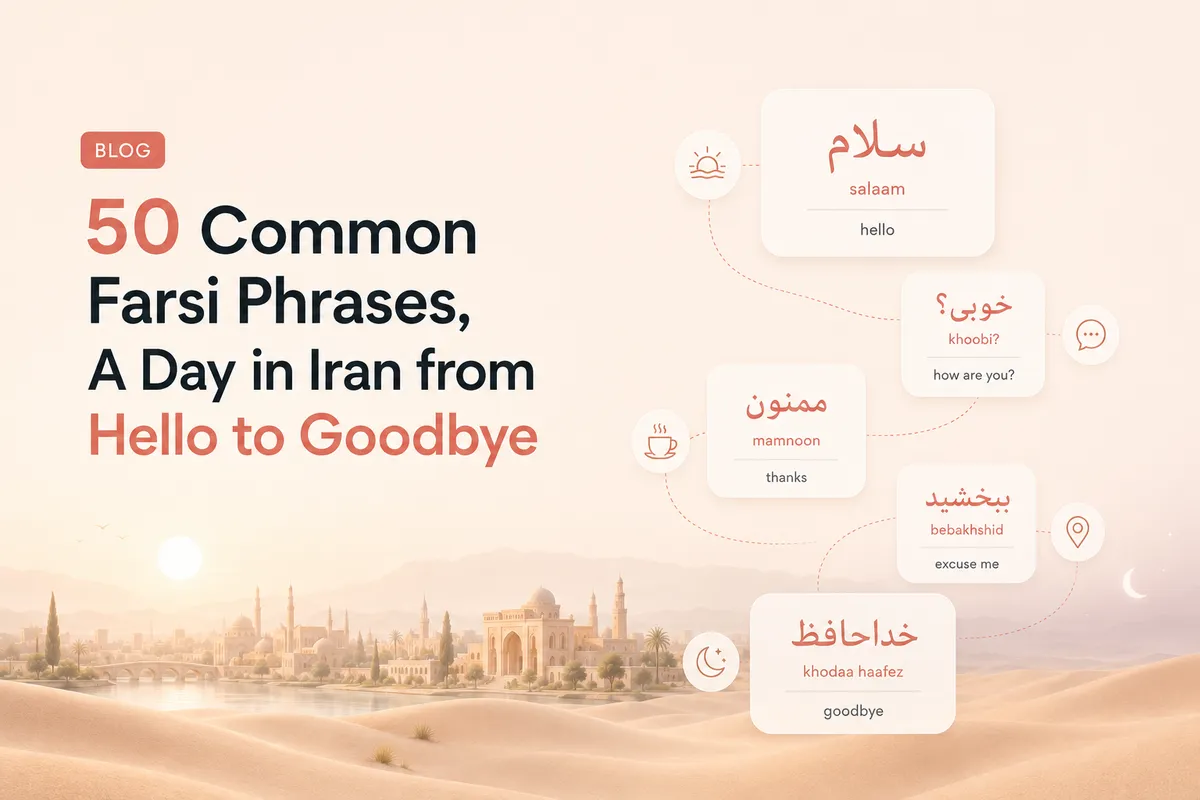
50 common Farsi phrases with Persian script and pronunciation, grouped by situation. Greetings, thanks, directions and goodbyes you will actually use.
Walking Through a Day in Persian
Most phrase lists hand you 50 words by category, greetings here, numbers there, courtesy phrases over there, and trust you to figure out which one to actually say when you're standing in a Tehran taxi.
This one is different. We've ordered the 50 most common Farsi phrases the way you'll actually use them: from your first hello in the morning to your last goodbye at night. Each phrase comes with Persian script, the way native speakers actually pronounce it (not the textbook version), and the line that usually comes back at you.
If you only have an hour to prepare for a trip, a call, or your first dinner with a Persian-speaking family, read this top to bottom once. You'll cross about 80% of the daily ground.
1. Your First 30 Seconds, Hello and Introductions (Phrases 1–8)
Iranians notice effort fast. The opening exchange sets the tone for everything that follows.
- سلام (salaam), Hello
- صبح بخیر (sobh bekheyr), Good morning
- حال شما چطوره؟ (hal-e shomaa chetore?), How are you? (formal)
- چطوری؟ (chetori?), How are you? (informal, between friends)
- خوبم، ممنون. شما؟ (khoobam, mamnoon. shomaa?), I'm good, thank you. You?
- اسم من ... است (esm-e man ... ast), My name is ...
- اسم شما چیه؟ (esm-e shomaa chiyeh?), What's your name?
- از آشنایی شما خوشبختم (az aashenaayi-ye shomaa khoshbakhtam), Nice to meet you
The conversation pattern: Almost every first encounter goes salaam → chetori? → khoobam, mamnoon, shomaa? → khoobam. Memorise that four-step exchange and you can handle the opening of any conversation in Iran. The exact reply you get depends on age and formality, but the rhythm is the same.
For a deeper look at greetings only, see our Farsi greetings guide.
2. Reading the Room, Politeness and Taarof (Phrases 9–17)
Persian politeness (taarof) runs the social fabric. These phrases are how it shows up in the wild.
- ممنون (mamnoon), Thank you
- خیلی ممنون (kheyli mamnoon), Thank you so much
- خواهش میکنم (khaahesh mikonam), You're welcome / Please (the polite-please)
- لطفاً (lotfan), Please (the asking-please)
- ببخشید (bebakhshid), Excuse me / Sorry
- قابلی نداره (ghaabeli nadaareh), It's nothing / Don't mention it (often: "it's on the house")
- چشم (cheshm), On my eyes (used like "of course, will do")
- خسته نباشی (khaste nabaashi), May you not be tired (said to someone working)
- دستت درد نکنه (dastet dard nakone), May your hand not hurt (deep thanks for effort)
The taarof trap. A shopkeeper saying ghaabeli nadaareh ("it's not worthy of you") does NOT mean the item is free. It's a ritual exchange. You insist on paying two or three times, they accept. New visitors to Iran sometimes walk away thinking they got a gift; locals find this very funny.
Full breakdown in our guide to taarof.
3. Out and About, Taxis, Cafés, Bazaars (Phrases 18–30)
Once you're moving through a city, this is the working set.
In a taxi: 18. این آدرس لطفاً (in aadres lotfan), This address please 19. لطفاً همینجا نگه دارید (lotfan hamin-jaa negah daarid), Please stop here 20. چقدر شد؟ (cheghadr shod?), How much was it?
At a café or restaurant: 21. یک میز برای دو نفر لطفاً (yek miz baraaye do nafar lotfan), A table for two please 22. منو لطفاً (menu lotfan), Menu please 23. آب میخوام (aab mikhaam), I want water 24. این چیه؟ (in chiye?), What is this? 25. خیلی خوشمزه بود (kheyli khoshmaze bood), It was delicious 26. حساب لطفاً (hesaab lotfan), The bill please
At the bazaar: 27. این چقدره؟ (in cheghadre?), How much is this? 28. ارزونتر میشه؟ (arzoon-tar mishe?), Can it be cheaper? 29. گرونه (geroone), It's expensive 30. میخرمش (mikharamesh), I'll take it
The bargaining rhythm. In Tehran bazaars, asking arzoon-tar mishe? once is expected. Twice is normal. Three times starts to feel pushy. Bargaining is mostly about warmth and a handshake, not the discount.
4. At Someone's House, Persian Hospitality (Phrases 31–37)
If you get invited home, you've crossed a line very few tourists cross. These phrases keep you on the right side of it.
- ممنون از دعوت (mamnoon az davat), Thank you for the invitation
- خونتون قشنگه (khoonetoon ghashange), Your home is beautiful
- نوش جان (noosh-e jaan), Bon appetit (said by the host)
- خیلی خوشمزهست (kheyli khoshmazast), It's delicious
- سیر شدم، ممنون (sir shodam, mamnoon), I'm full, thank you
- زحمت کشیدید (zahmat keshidid), You went to so much trouble (said before leaving)
- باید برم (baayad beram), I have to go
The food trap. A Persian host will refill your plate even after you say sir shodam. They're not ignoring you, this is normal hospitality. The trick is to leave a small amount on the plate at the end. An empty plate signals "please give me more." A small remainder signals "I'm content."
5. When You're Stuck, Asking for Help (Phrases 38–43)
Every learner reaches the wall where the conversation outpaces them. These six phrases get you back into the conversation gracefully.
- نمیفهمم (nemifahmam), I don't understand
- فارسی بلد نیستم (faarsi balad nistam), I don't know Farsi
- کمی فارسی بلدم (kami faarsi baladam), I know a little Farsi
- لطفاً آهستهتر صحبت کنید (lotfan aaheste-tar sohbat konid), Please speak more slowly
- میتونید تکرار کنید؟ (mitoonid tekraar konid?), Can you repeat?
- به انگلیسی چی میشه؟ (be engelisi chi mishe?), What is this in English?
The phrase that opens the most doors: kami faarsi baladam. Saying "I know a little Farsi" (instead of "I don't know Farsi") almost always switches the other person into slow, gentle, beginner-friendly Farsi. They want you to succeed.
6. The Numbers You'll Actually Reach For (Phrases 44–48)
We're not listing all the numbers, just the five most commonly heard out loud in real situations.
- یکی (yeki), One ("I'll take one")
- دو تا (do taa), Two ("two please")
- چند تا؟ (chand taa?), How many?
- چقدر؟ (cheghadr?), How much?
- نصف (nesf), Half
The full counting numbers (yek, do, seh, chahaar, panj...) sit in the vocabulary lessons. In speech, you'll hear yeki and do taa (with the colloquial counter -taa) much more than the bare numbers from a textbook.
7. The Graceful Exit, Saying Goodbye (Phrases 49–50)
Persian goodbyes are short on the page but long in person, the actual exchange usually involves at least one ghorboon-e shomaa and a handshake.
- خداحافظ (khodaahaafez), Goodbye (literally: God protect you)
- به امید دیدار (be omid-e didaar), Hope to see you again
The send-off ritual. A Persian goodbye between people who like each other often runs: khodaahaafez → khodaahaafez → ghorboon-e shomaa (I sacrifice myself for you) → maraahem (you are kind to me) → khodaahaafez → khodaahaafez. It can take three minutes. Don't rush it. The length of the goodbye is the warmth of the bond.
Pronunciation Cheats That Actually Work
Transliteration only gets you 70% of the way. Four cheats close most of the rest.
- kh (خ) is a back-of-throat sound, the "ch" in Scottish loch. Common in khodaahaafez, khoob.
- gh (ق, غ) is even further back, almost a soft gargle. Common in cheghadr, ghahve.
- aa (long a, written as ا) is the "a" in father, not the "a" in cat. Salaam, not "sal-AM."
- e at the end of a word is pronounced. Khoobe is two syllables ("khoo-beh"), not one.
If you only fix the long aa sound, you'll already sound noticeably more native to a Persian ear. It's the single highest-leverage adjustment.
For the full sound system, see our Farsi pronunciation guide.
How to Practice So They Actually Stick
Reading a phrase list once is the easy bit. Making the phrases come out under pressure is the harder bit.
Run the day in your head. Walk through a fake morning in Tehran: you wake up, greet a host (salaam, sobh bekheyr), order a coffee (ghahve lotfan), pay (cheghadr shod?), thank the barista (mamnoon). Each segment should take 30 seconds. Run the loop until the phrases stop needing thought.
Pick five per day to actually say out loud. Don't try to drill all 50. Five phrases × two weeks = 70 phrases internalised, with room for repetition.
Pair them with a real face. If you have a Persian-speaking friend, family member, or partner, ask them which five phrases would land best the first time you use them. Personalised picks beat generic lists.
When you're ready to go beyond phrase memorisation into actual grammar and vocabulary structure, the free Farsi lessons build on the foundation these phrases give you. Or if you want to know what to expect on a real trip, see essential Farsi for travel to Iran. And to talk about the people around you, learn the Farsi family words.