Persian Verb Conjugation for Beginners
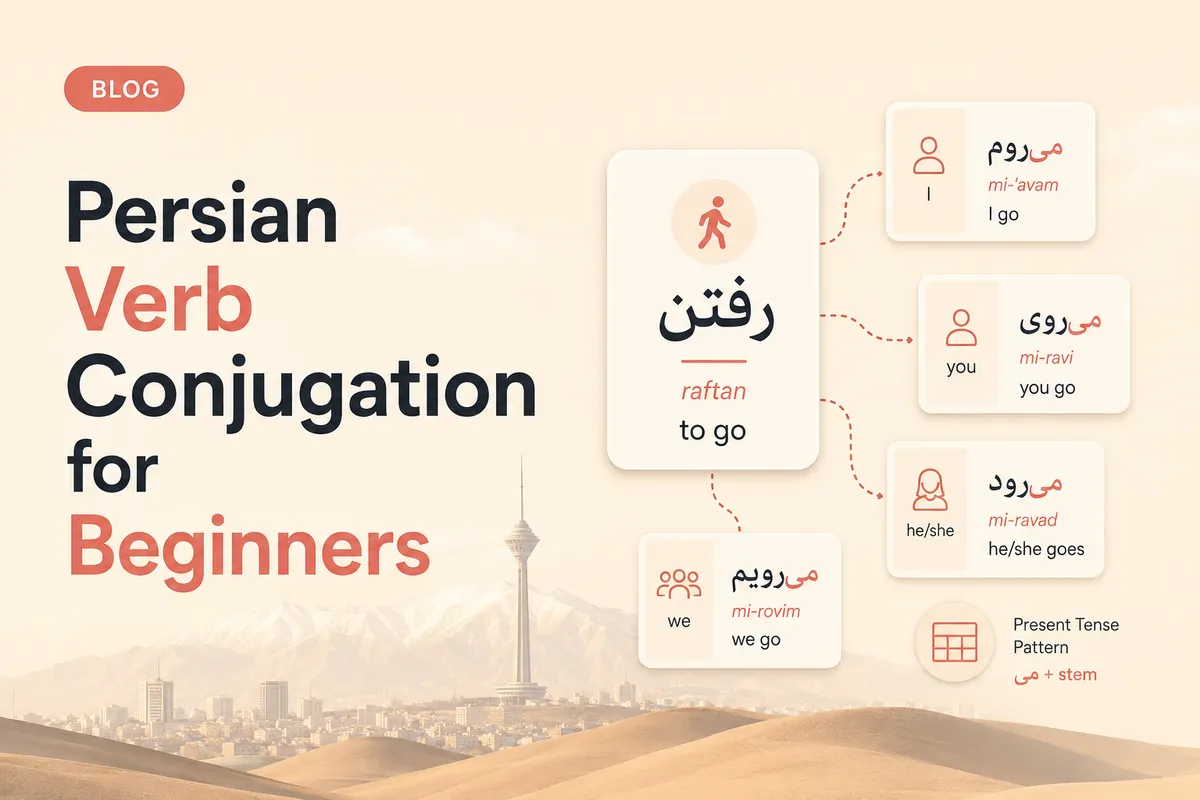
Persian verb conjugation for beginners. Learn the present and past tense, personal endings, and to be, with clear examples and free Farsi practice.
Persian Verbs Are Regular
Persian verb conjugation is friendlier than many languages. Endings are steady, and there are few exceptions.
Each verb has a present stem and a past stem. You add personal endings to show who does the action.
Learn the pattern once, and you can conjugate most verbs.
The Personal Endings
The same set of endings shows the person:
- ,am (I)
- ,i (you)
- ,ad / ,e (he, she, it)
- ,im (we)
- ,id (you plural)
- ,and / ,an (they)
These endings attach to the verb stem. Learn them first, and the rest follows.
Present and Past Tense
Take khordan (to eat), stem khor:
- Present adds mi, plus endings: mikhoram (I eat), mikhori (you eat).
- Past uses the past stem khord: khordam (I ate), khordi (you ate).
The verb budan (to be) is common: hastam (I am), hasti (you are).
Same endings, two stems. That is the whole system.
Practice Persian Verbs
Pick two or three common verbs and drill them in both tenses. Say full sentences, not just endings.
Strengthen this with the Persian ezafe guide and our Farsi grammar basics.
Start with the free grammar lessons on Learn Farsi and conjugate along.