Farsi Grammar for Beginners: the Basics Made Simple
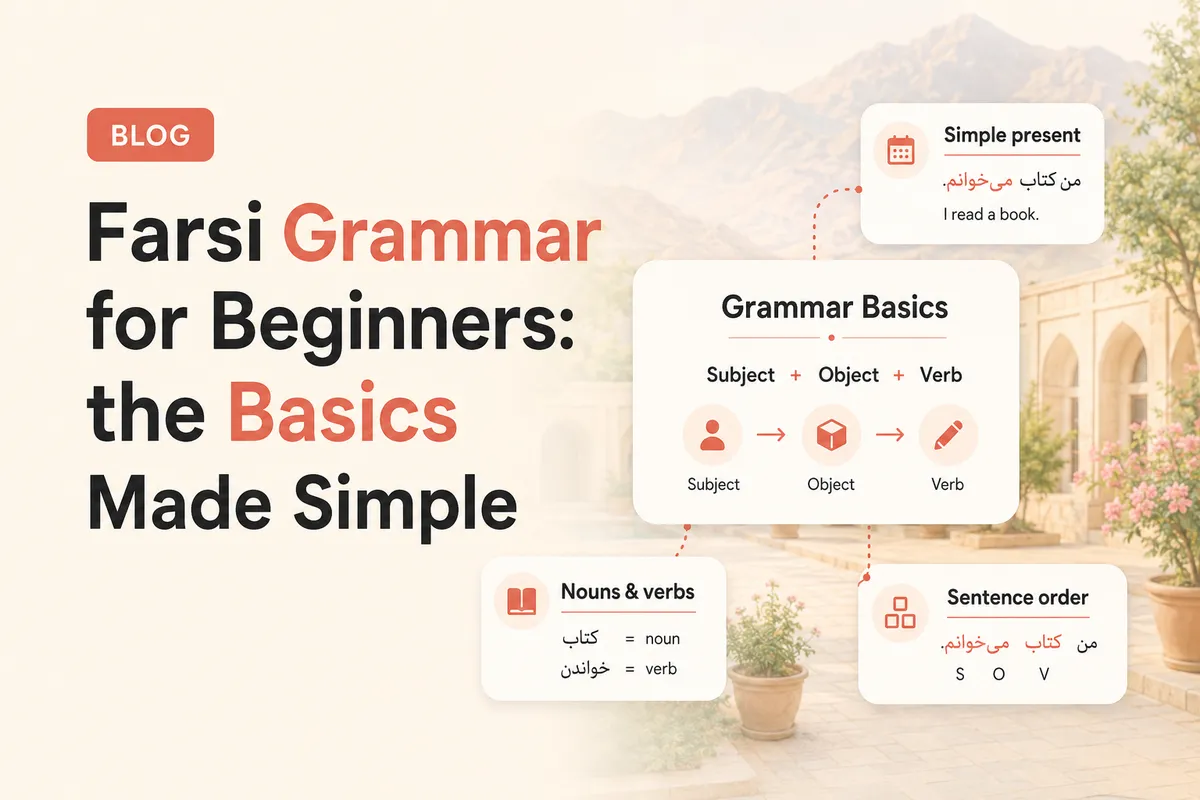
Farsi grammar for beginners made simple. Learn word order, the ezafe, the mi- prefix, the verb budan, and plurals with clear Persian examples on Learn Farsi.
Farsi Grammar for Beginners
Farsi grammar is simpler than many learners expect. There are no gendered nouns and few irregular rules. This guide makes the basics easy.
You will learn word order, the ezafe, the present tense, the verb "to be", and plurals. Each part comes with a short example.
Take it one step at a time. By the end, you will understand how Persian sentences fit together.
Word Order: Subject Object Verb
Persian usually follows Subject, Object, Verb order. The verb comes at the end of the sentence.
For example:
- من کتاب میخوانم (man ketab mikhanam), I read a book.
Here "man" is the subject, "ketab" is the object, and "mikhanam" is the verb. The verb sitting last is the key habit to learn.
The Ezafe: the Linking -e
The ezafe is a small linking sound, said as -e. It joins a noun to the word that describes or owns it.
For example:
- کتابِ من (ketab-e man), my book.
- خانهٔ بزرگ (khane-ye bozorg), the big house.
The ezafe is often not written, but you still say it. It links words like invisible glue.
Present Tense With the mi- Prefix
To make the present tense, add the prefix mi- to the verb stem. Then add an ending for the person.
For example, from the verb "to go":
- من میروم (man miravam), I go.
- تو میروی (to miravi), you go.
The mi- prefix marks ongoing or habitual action. Learn it once and it works across many verbs.
The Verb budan: to Be
The verb budan means "to be". In the present tense, it often attaches to the end of a word as a short ending.
For example:
- من خوشحالم (man khoshhalam), I am happy.
- او معلم است (u moallem ast), he or she is a teacher.
These short endings replace a separate word for "am" or "is". They are quick to learn and very common.
Plurals With -ha
To make most nouns plural, add the suffix -ha. It works for objects and ideas in a simple way.
For example:
- کتاب (ketab), book becomes کتابها (ketabha), books.
- خانه (khane), house becomes خانهها (khaneha), houses.
This one rule covers a huge number of words. For more practice, see our Farsi grammar lessons.
Keep Practicing Farsi Grammar
Grammar makes sense once you use it in real sentences. Practice a little each day and the patterns become natural.
Mix grammar with vocabulary so you can build full sentences. Reading short examples out loud helps a lot.
Ready to start? Open the free lessons on Learn Farsi and put this grammar to work today. For a daily structure around it, see our plan for learning Farsi online. Ready for a trickier point? See how the Persian ezafe links words together.