The Ezafe in Persian, Explained Simply
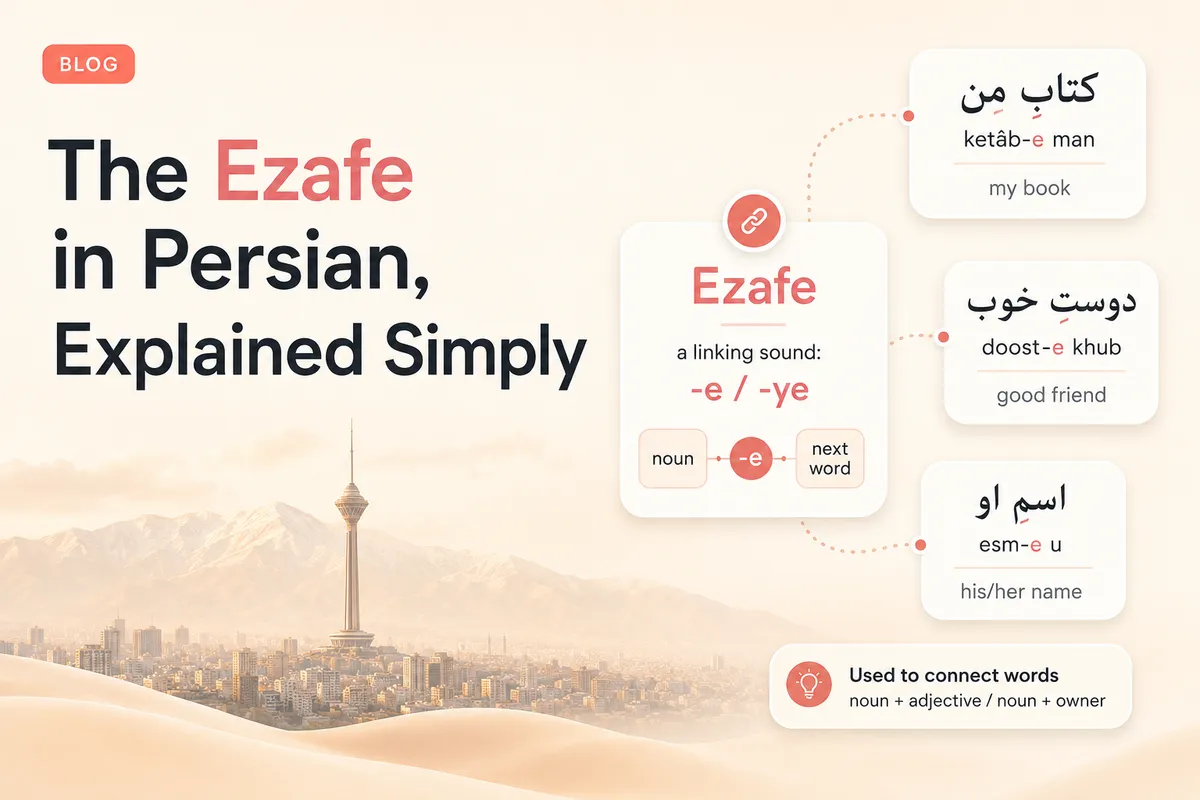
Learn Persian ezafe with clear rules, audio examples and a free 10-question practice. Connect nouns, adjectives and possessors, then check your understanding.

Free web lesson · About 7 minutes
Man means I/me. Read the pronunciation below each example.
Go to practice →1. Say the thing first
Add -e before its owner or description: ketâb-e man = my book. After consonants, this sound is usually not written.
2. Link each word
Ketâb-e jadid-e man = my new book. Add -e between the linked words, not after the last one.
3. Sometimes use -ye
After â, u or a final pronounced e, use -ye: khâne-ye man = my house. In speech, khâne often becomes khune.
Quick guide
- Owner
- ketâb + -e + man → ketâb-e man
- Description
- dust + -e + khub → dust-e khub
- Vowel ending
- sedâ + -ye + khub → sedâ-ye khub
- A chain
- ketâb-e jadid-e man → my new book
Examples
کتاب من
ketâb-e man
my book
دوست خوب
dust-e khub
a good friend
ماشین قرمز
mâshin-e ghermez
the red car
در خانه
dar-e khâne
the door of the house
کتاب جدید من
ketâb-e jadid-e man
my new book
صدای خوب
sedâ-ye khub
a good voice
خانهٔ من
khâne-ye man
my house (khune-ye man in everyday speech)
Remember
- Say ketâb-e man, not man-e ketâb.
- Ezafe links words. It does not mean “is”.
Try it yourself
10 questions, instant feedback. Answer at least 80% correctly to complete this lesson. No account needed.
Related: Persian grammar basics · Verb conjugation