Persian Diacritics and the Half-Space Explained
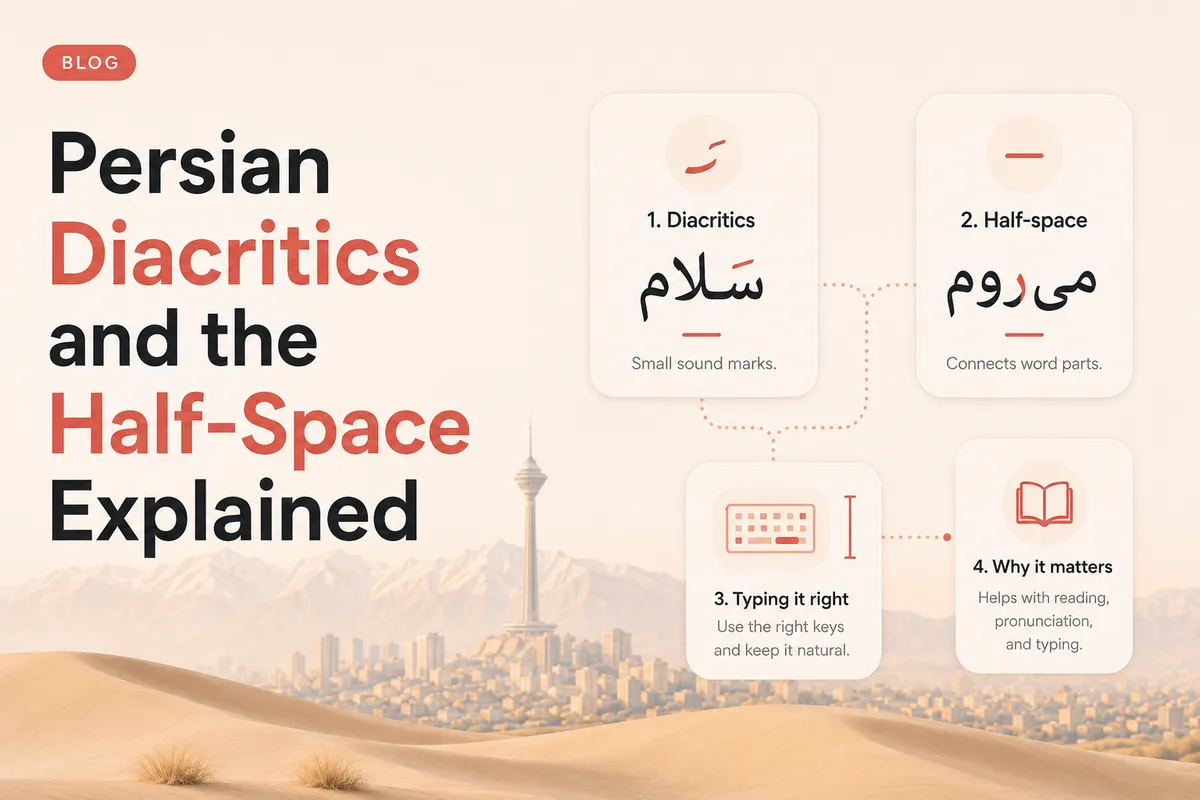
A simple guide to Persian diacritics: the short vowels, tashdid, hamze, and the half-space (ZWNJ). Learn the marks beyond the 32 letters and how to read them.
The Marks Beyond the 32 Letters
Persian has 32 letters, but that isn't the whole story. A handful of small marks, the Persian diacritics, plus one invisible character, shape how words are written and read.
Most of these marks are optional. Native readers fill them in from context. Still, knowing them makes reading much easier.
Here is each one in plain language, with a real example.
Short Vowels: Zebar, Zir, and Pish
Persian has three short vowels: a, e, and o. They are the most common diacritics, and they are usually left out.
When written, they sit above or below a letter:
- Zebar (◌َ), a small stroke above, is the sound "a", as in دَر (dar, door).
- Zir (◌ِ), a stroke below, is "e", as in کِتاب (ketâb, book).
- Pish (◌ُ), a small loop above, is "o", as in گُل (gol, flower).
You will mostly see these in children's books and textbooks. Everywhere else, your brain supplies the vowel.
Tashdid, Sukun, and Tanvin
Three more marks show up now and then.
Tashdid (◌ّ) doubles a letter, so you hold the sound a little longer, as in بچّه (bachche, child).
Sukun (◌ْ) marks a letter with no vowel after it.
Tanvin (◌ً) adds an "-an" ending, seen in words like لطفاً (lotfan, please).
None of these are daily essentials. Learn to recognise them, then move on.
Hamze and Alef Madde
Two special forms round out the set.
Hamze (ء) is a small glottal catch, like the pause in "uh-oh". It sits alone or on a carrier, as in سؤال (so'âl, question).
Alef madde (آ) is an alef with a hat. It writes a long "â" at the start of a word, as in آب (âb, water).
The Half-Space (ZWNJ)
The most useful character is invisible. The half-space, or zero-width non-joiner (ZWNJ), separates parts of a word without a full space.
You see it in verb prefixes like میروم (miravam, I go) and plurals like کتابها (ketâb-hâ, books). Without it, the letters would wrongly join up.
To type it, press Shift + Space on most keyboards. Our guide to adding a Persian keyboard covers this step by step.
The Ezafe: the Unwritten Linker
One sound is almost never written at all. The ezafe is a short "-e" that links two words, as in کتابِ من (ketâb-e man, my book).
It is spoken constantly but rarely marked. You learn to add it by ear as your vocabulary grows.
For the grammar behind it, see our Farsi grammar guide.
How to Learn These Marks
Don't try to master every mark at once. Learn them as you meet them in real words.
Start with the three short vowels and the half-space, since those appear most. The rest settle in with reading practice.
Our interactive Persian alphabet trainer lets you practise the letters, their forms, and these marks side by side. For the full letter tour, read our Persian alphabet guide.