How Many Letters Are in the Persian Alphabet? All 32 Listed
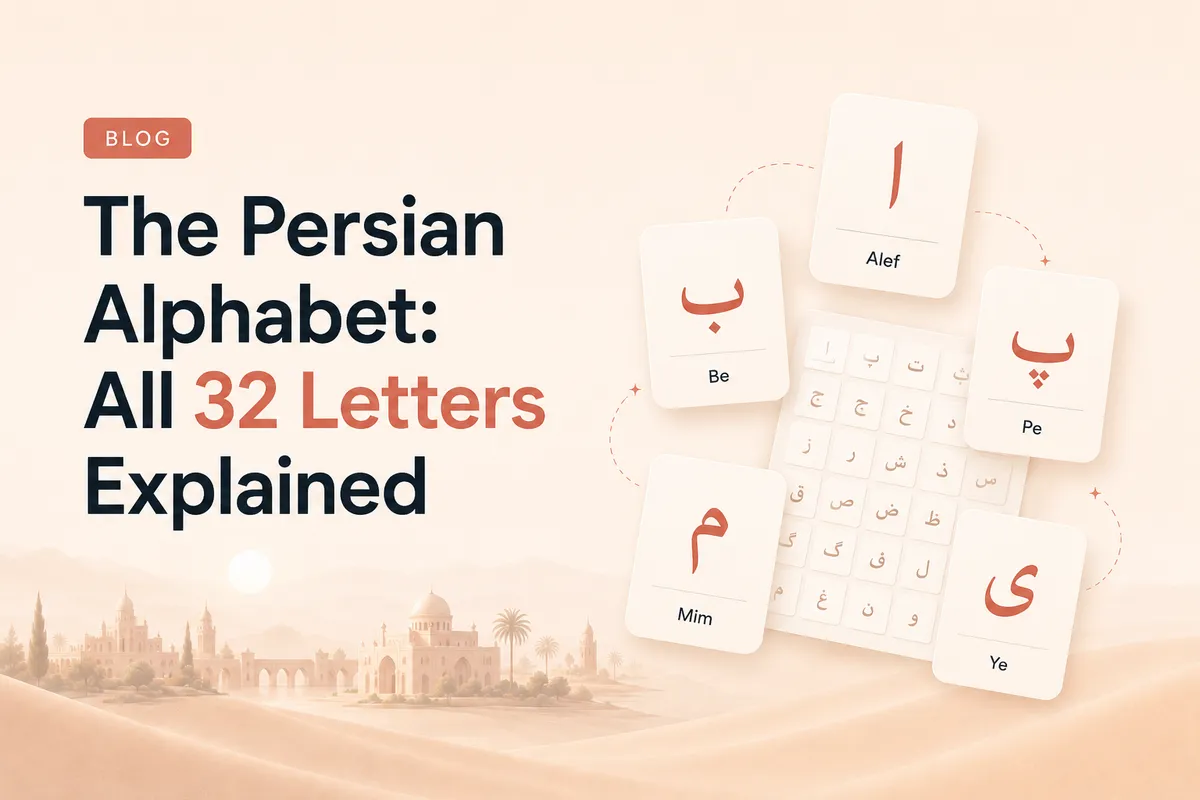
The Persian alphabet has 32 letters: the 28 Arabic letters plus پ, چ, ژ and گ. See all 32 with their sounds, four written forms, and how they join in a word.
Overview of the Persian Alphabet
The Persian alphabet has 32 letters. It's written right to left in a cursive script where most letters connect.
Short vowels usually aren't written. Readers figure them out from context, similar to how you read abbreviations in English.
The script comes from Arabic, but Persian adds four extra letters. Despite looking complex, it's largely phonetic. Each letter maps to a consistent sound.
Most learners start reading simple words within one to two weeks of focused practice.
How Persian Differs from Arabic Script
Persian and Arabic share a script, but they're not identical.
Persian adds four letters for sounds Arabic doesn't have: "pe" (پ) for /p/, "che" (چ) for /ch/, "zhe" (ژ) for /zh/, and "gaf" (گ) for hard /g/.
Persian also pronounces some shared letters differently. The letter "ع" (eyn) is a full glottal stop in Arabic but softer in Persian. Several Arabic emphatic consonants sound identical to their plain versions in Farsi.
This means Persian has multiple letters for the same sound. You just memorize the spelling, like choosing between "see" and "sea" in English.
The Four Unique Persian Letters
These four letters make Persian distinct from Arabic:
"Pe" (پ), the /p/ sound, as in "pedal" (پدال). Looks like "be" (ب) but with three dots below.
"Che" (چ), the /ch/ sound, as in "chay" (چای, tea). Looks like "jim" (ج) with three dots.
"Zhe" (ژ), the /zh/ sound, as in "zhale" (ژاله, dew). Looks like "ze" (ز) with three dots above.
"Gaf" (گ), the hard /g/ sound, as in "gol" (گل, flower). Similar to "kaf" (ک) with an extra stroke.
These appear in everyday Farsi, so learn them early.
Letter Forms: Initial, Medial, Final, and Isolated
Because Persian is cursive, most letters change shape based on their position in a word. Each letter has up to four forms: isolated, initial, medial, and final.
Six letters only connect to the letter before them, never after. These "non-connectors" are: alef (ا), dal (د), zal (ذ), re (ر), ze (ز), and zhe (ژ). When they appear, the next letter starts fresh.
This sounds like a lot to memorize, but many letters share the same base shape. They differ only in dots. Learn one group and the rest follow quickly.
Practice by copying words by hand. Pay attention to how each letter flows into the next.
Short Vowels and Diacritics
Persian has three short vowels: /a/, /e/, and /o/. They're usually not written.
When they do appear, they show up as small marks: a diagonal stroke above for /a/ (zebar), below for /e/ (zir), and a small loop above for /o/ (pish).
You'll see these marks in children's books and textbooks. Everywhere else, newspapers, websites, street signs, they're left out.
This is less scary than it sounds. English works similarly. You read "I read a book" without confusion, even though "read" has two pronunciations. Your brain fills in the gaps. Same thing happens in Farsi once you build vocabulary.
Other Marks and the Half-Space
A few more marks show up beyond the short vowels.
Tashdid (ـّ) doubles a letter, so you hold the sound a little longer, as in "bachche" (بچّه, child). Hamze (ء) is a small glottal catch, like the pause in "uh-oh". Tanvin (ـً) adds an "-an" ending, seen in words like "lotfan" (لطفاً, please).
One character is invisible but important: the half-space (نیمفاصله). It separates parts of a word without a full space, as in "miravam" (میروم, I go) and plurals like "ketâb-hâ" (کتابها, books).
You don't need to master these on day one. Learn them as you meet them. Our interactive Persian alphabet trainer lets you practise the letter forms and these marks side by side.
Tips for Learning the Persian Script
Group letters by base shape. For example, "be" (ب), "pe" (پ), "te" (ت), and "se" (ث) all look the same except for dots. This cuts the memorization work.
Write by hand every day, even just ten minutes. Physical writing builds motor memory that typing doesn't.
Start reading real Farsi as soon as you can. Shop signs, food labels, and social media posts are great sources. Sound out each word letter by letter.
This feels slow at first but speeds up fast. Within a few weeks, you'll read with growing confidence.
Wondering how Persian script compares to Arabic? Read Farsi vs Arabic: what's the difference?. For a full beginner roadmap, see how to learn Farsi. In a hurry? Try our method to memorize the Persian alphabet in 7 days.