Farsi vs Arabic: What's the Difference?
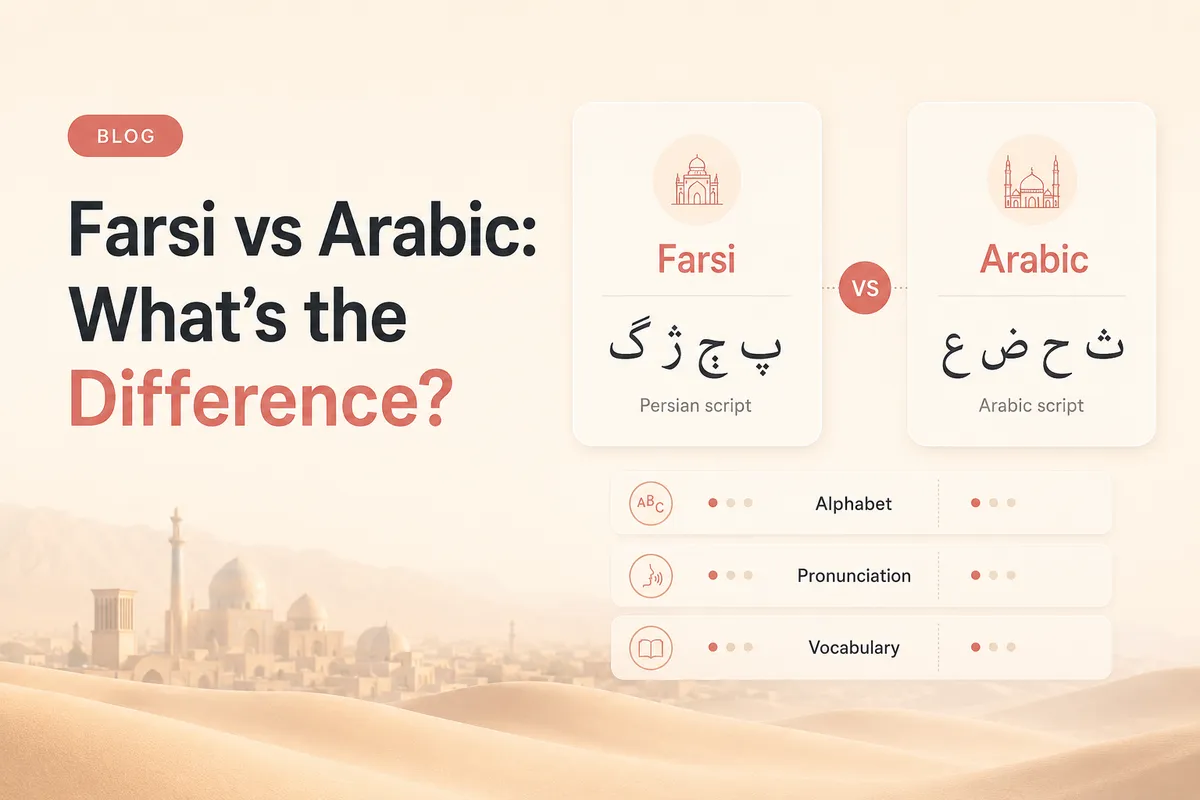
Farsi and Arabic share a script but are completely different languages. Learn the key differences in grammar, vocabulary, pronunciation, and structure.
They're Different Language Families
This is the most important thing to understand: Farsi and Arabic belong to entirely different language families.
Farsi is an Indo-European language, part of the Iranian branch. It's related to Kurdish, Pashto, and even distantly to English, French, and Hindi. Arabic is a Semitic language, related to Hebrew and Aramaic.
This means their grammar, sentence structure, and core vocabulary developed independently. They share a script and some borrowed words, but the underlying languages are fundamentally different.
For more on what Farsi actually is, see our post on Farsi vs Persian.
The Script Looks Similar, But Isn't the Same
Both Farsi and Arabic use a script that reads right to left and looks visually similar. However, Farsi has four extra letters that don't exist in Arabic:
- پ (pe), the "p" sound
- چ (che), the "ch" sound
- ژ (zhe), like the "s" in "measure"
- گ (gaf), the hard "g" sound
Arabic doesn't have these sounds natively. If you see پ, چ, ژ, or گ in a text, it's almost certainly Farsi (or Urdu), not Arabic.
Learn all 32 Persian letters with our alphabet course. For a deeper dive, read our complete guide to the Persian alphabet.
Grammar Differences
Farsi grammar is significantly simpler than Arabic in several ways.
No grammatical gender. Arabic has masculine and feminine forms for nouns, adjectives, and verbs. Farsi has none.
No noun cases. Arabic uses case endings that change word forms. Farsi uses prepositions instead, similar to English.
Simpler verb system. Arabic verbs follow a root-and-pattern system with dozens of forms. Farsi verbs use a stem plus regular endings, more like European languages.
Word order. Farsi follows Subject-Object-Verb (SOV) order. Arabic follows Verb-Subject-Object (VSO). This is a fundamental structural difference.
These differences mean the two languages require very different learning approaches. Explore Farsi grammar with our structured lessons.
Shared Vocabulary
Despite being different languages, Farsi has borrowed heavily from Arabic, especially in formal, religious, and academic vocabulary. Estimates suggest 25-40% of Farsi words have Arabic origins.
Common examples:
- کتاب (ketab) means "book" in both languages
- مدرسه (madreseh) means "school" in both
- سلام (salaam) means "hello/peace" in both
However, many borrowed words are pronounced differently in Farsi. And everyday conversational Farsi uses mostly native Persian words, not Arabic loanwords.
This overlap means that learning one language gives you a small vocabulary head start in the other, but the grammar and structure are too different to transfer directly.
Which Should You Learn?
It depends on your goals.
Choose Farsi if: you're interested in Iranian culture, have Persian-speaking family, plan to travel to Iran, or want a language with relatively simple grammar.
Choose Arabic if: you're interested in the broader Middle East, want to read the Quran in its original language, or are drawn to Arabic literature and media.
Farsi is generally considered easier for English speakers due to its simpler grammar and Indo-European roots. But both are rewarding languages with rich cultural traditions.
Ready to start Farsi? Jump into our free lessons and see how quickly you can progress.