Farsi for Beginners: Where to Start
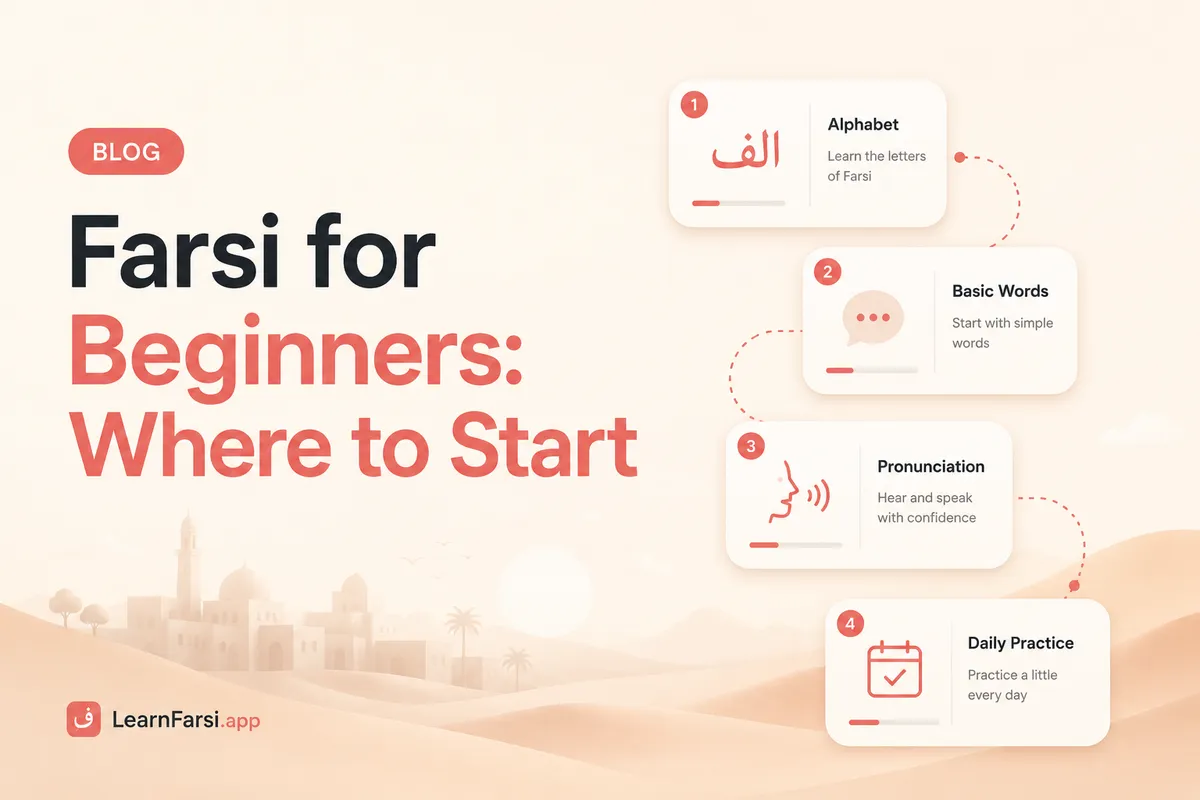
New to Farsi? This beginner's guide shows you exactly where to start, what to learn first, and how to build a study routine that works.
Starting Farsi: What to Learn First
Starting a new language can feel overwhelming. Farsi has a different script, new sounds, and unfamiliar grammar. But here's the good news: Farsi is more logical and consistent than most languages.
This guide gives you a clear path. No guesswork, no wasted time. Just the steps that work for beginners.
Step 1: Learn to Say the Basics
Before anything else, learn 10 survival phrases:
- Salam (Hello)
- Mersi (Thank you)
- Baleh / Na (Yes / No)
- Bebakhshid (Excuse me)
- Chetori? (How are you?)
- Man ___ hastam (I am ___)
- Lotfan (Please)
- Khodahafez (Goodbye)
- Farsi balad nistam (I don't speak Farsi)
- Inja koja-st? (Where is this?)
You don't need the alphabet for this. Start with phonetic pronunciation and focus on speaking from day one.
Step 2: Learn the Alphabet (or Don't)
The Persian alphabet has 32 letters. It reads right-to-left. Letters change shape depending on their position in a word.
Should you learn it? It depends on your goals:
- Want to read and write? Learn the alphabet early. Spend 1-2 weeks on it.
- Just want to speak? Skip it for now. Use phonetic transcription and come back to the alphabet later.
Both approaches work. Our alphabet page teaches all 32 letters with audio pronunciation for each one.
Step 3: Build Core Vocabulary
Focus on the 100 most common words. These cover about 50% of everyday conversations. Start with:
- Pronouns: man, to, oo, ma, shoma, anha
- Numbers 1-10: yek, do, se, chahar, panj, shesh, haft, hasht, noh, dah
- Common verbs: raftan (go), amadan (come), khordan (eat), goftan (say), didan (see)
- Everyday nouns: ab (water), nan (bread), khaneh (house), kar (work)
Our vocabulary lessons teach these in structured order with spaced repetition to help you remember them.
Step 4: Understand Basic Grammar
Farsi grammar is simpler than most European languages. Key things to know:
- Word order: Subject-Object-Verb (I rice eat)
- No gender: No masculine or feminine words
- No articles: No "the" or "a"
- Verb endings: Add endings to verb stems to show who is doing the action
Don't study grammar in isolation. Learn it through sentences and practice. Our grammar lessons teach these patterns through interactive exercises. For a deeper look, read our Farsi grammar basics guide.
Step 5: Practice Every Day
Consistency beats intensity. Fifteen minutes every day is better than two hours on weekends.
A simple daily routine for beginners:
- 5 min: Review yesterday's words with daily practice (spaced repetition)
- 5 min: Learn a new lesson (vocabulary or grammar)
- 5 min: Listen to Farsi audio (podcast, YouTube, or lesson audio)
Track your streak on the dashboard. Even a small streak builds momentum.
For more tips on learning efficiently, read our guide on how to learn Farsi fast. For an easy vocabulary win, learn the colors in Farsi.
Common Beginner Mistakes to Avoid
- Trying to learn everything at once. Focus on the top 100 words first, not thousands.
- Studying grammar before speaking. Speak from day one, even if it's just greetings.
- Not reviewing. New words disappear without review. Use spaced repetition.
- Perfectionism. You don't need perfect pronunciation to be understood. Good enough is good enough.
- Skipping daily practice. Five minutes daily beats an hour once a week.
Farsi is a rewarding language to learn. The hardest part is starting. You're already here, so you've done that.
When you want a routine to follow, our guide to learning Farsi online sets out a three-step daily plan that fits into ten minutes.