Learning Farsi: Your Complete Language Guide
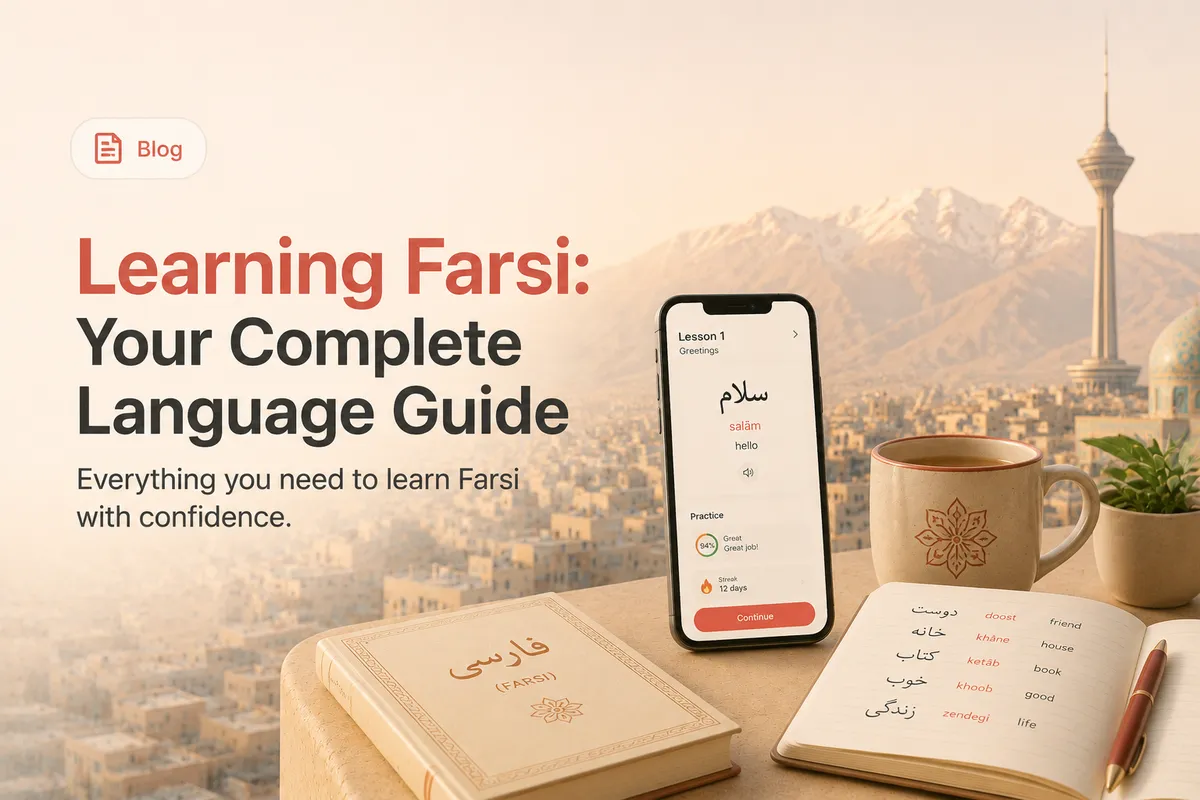
Everything you need to know about learning the Farsi language. From the alphabet to grammar and conversation, a complete roadmap for every level.
What Is the Farsi Language?
Farsi, also called Persian, is an Indo-European language spoken by over 110 million people. It's the official language of Iran, and closely related varieties are spoken in Afghanistan (Dari) and Tajikistan (Tajik).
Learning the Farsi language opens the door to one of the world's oldest literary traditions. Poetry by Rumi, Hafez, and Ferdowsi is still read and loved today.
Despite using the Arabic script, Farsi is not Arabic. It belongs to a completely different language family and has its own grammar, vocabulary, and sound system.
Is Farsi Hard to Learn?
Farsi is easier than most people expect. The U.S. Foreign Service rates it as a Category 3 language, meaning it takes roughly 600-750 hours to reach professional proficiency.
The good news:
- No grammatical gender (no masculine/feminine)
- No noun cases (unlike German or Russian)
- No articles (no "the" or "a")
- Regular verb conjugation patterns
- Many French and English loanwords
The script takes 1-2 weeks to learn. After that, Farsi is surprisingly consistent. For a deeper look, read our guide on whether Farsi is hard to learn.
The Farsi Alphabet
Farsi uses a modified Arabic script with 32 letters. It reads right-to-left. Four letters are unique to Farsi and don't exist in Arabic: پ (pe), چ (che), ژ (zhe), and گ (gaf).
Letters change shape depending on their position in a word (initial, medial, final, or isolated). This sounds complex, but the patterns repeat and become natural with practice.
Our complete Persian alphabet guide covers all 32 letters with pronunciation and examples. You can also practice on our interactive alphabet page.
Farsi Grammar Essentials
Farsi uses Subject-Object-Verb (SOV) word order. "I rice eat" instead of "I eat rice." This feels odd for a few days, then becomes natural.
Verbs conjugate by adding endings to a stem. There are two stems per verb: present and past. Learn the 10 most common verbs and you can build hundreds of sentences.
The ezafe (-e) connects nouns to adjectives: "ketab-e bozorg" means "big book" (literally "book of big"). It's one of the most important grammar features in Farsi.
For a full breakdown, read our Farsi grammar basics guide.
Building Your Vocabulary
The 80/20 rule applies: roughly 100 high-frequency words cover about 50% of everyday Farsi conversation. Start there.
Farsi has many loanwords you already know:
- From French: mersi (thank you), taksi (taxi), shokolat (chocolate)
- From English: telefon, internet, kompyuter
- From Arabic: salam (hello), mamnun (grateful), tashakor (thanks)
Our 100 basic Farsi words list gives you the foundation. Practice them with spaced repetition lessons to make them stick.
Best Resources for Learning Farsi
The right combination of tools makes all the difference. Here's what works:
- Structured lessons: Learn Farsi offers free vocabulary and grammar lessons with spaced repetition
- Listening: Chai and Conversation podcast, Persian YouTube channels
- Speaking: Language exchange on Tandem or HelloTalk
- Reference: Our Farsi Quickguide PDF for offline study
For a detailed roundup, check our guide on the best way to learn Farsi online.
Setting Realistic Goals
With 20-30 minutes of daily practice:
- Month 1-2: Basic greetings, numbers, common phrases, simple sentences
- Month 3-4: Past and present tense, 300+ words, short conversations
- Month 6-9: Intermediate level, can handle everyday situations
- Year 1-2: Comfortable conversations, reading simple texts
Consistency matters more than intensity. Fifteen minutes every day beats two hours on weekends. Track your progress with streaks on the dashboard.
For more on timelines, read how long it takes to learn Farsi.